
Brand just ranked #1 among 500 senior B2B CMOs. Most companies still don’t have a plan.
In McKinsey’s 2026 State of Marketing Europe report, branding ranked first out of 20 marketing priorities – ahead of AI, data privacy, ROI measurement, and budget management.
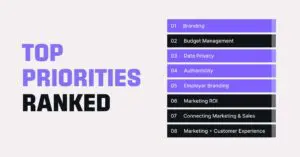
Of all 20 topics in the study, branding also has the largest gap between stated importance and actual execution maturity. Leaders ranked it first. They also rated themselves least prepared to act on it.
Too many organizations have simply been meaning to fix it. Quarter after quarter. While something else always moved to the front of the line. That delay has a very real cost – one that is giving competitors an unfair advantage.
Where most B2B brands actually are right now
Across the B2B organizations that come to S3 McMillan, the “brand problem” tends to show up in one of three ways.
- Brand has been underinvested in for years. And the pipeline is starting to show it.The strategy never quite got built, or it got built and then basically shelved when budgets tightened. A lack of true brand buy-in shows up in inconsistent messaging, a website that no longer reflects who the company is, and a sales team that pitches differently every time. This is pretty straightforward to diagnose – but often the last thing to get resourced because the belief in the performance power of brand isn’t there.
- The brand foundation is solid – but it has been sidelined by performance pressure.The positioning was built carefully. The messaging was right when it was written. But over the past few years of economic change, budget pressure pushed everything toward performance marketing and lead generation. The brand has been assumed rather than activated. Internal teams know all about the brand, and believe buyers do as well – so they are minimizing their top-of-funnel brand presence. Companies in this situation are often losing traction without a clear explanation for why.
- The brand was built for a market that no longer exists.A lot of B2B brands built genuine equity before the pandemic, before AI reshaped buyer behavior, before supply chain disruptions and economic shifts changed what customers actually need (and what they fear). What resonated in 2019, 2022, or even 2024 may not be what the market is responding to today. Competitors who have updated their positioning are picking up ground.
In all three cases, the starting point is the same: an unvarnished assessment of where the brand stands today, not where it stood when it was last reviewed. Every quarter that goes by without one gives competitors more opportunity to pull ahead.
What the numbers actually say
The McKinsey data is reframing how leading marketing executives think about the pipeline.
Three key stats about B2B buyers tell the story – called out specifically by Richella Odebrecht, Senior Vice President of Global Marketing for Industrial Automation at Schneider Electric:
- Only 5% of B2B buyers are actively shopping at any given moment.
- 80% already have a specific vendor in mind before they begin their research.
- 90% will choose from that pre-existing shortlist.
Sales calls, proposals, demos… Today, those are happening after most of the decision has already been made in many buyers’ minds. At the same time, noise levels are escalating.
Buyers are exposed to 4,000–10,000 brand messages daily – and McKinsey’s research shows ad fatigue is already driving click-through rates down by 40%. In that environment, the answer isn’t fewer messages. It’s messages that are differentiated enough to cut through.
And what’s coming next sharpens the urgency further: AI agents are already completing purchases and personalizing outreach on behalf of buyers. Autonomous vendor selection is not a distant scenario.
When an algorithm builds the shortlist, it pulls from what it can find and what it can understand. If a brand cannot be found and clearly categorized, it will not be on it.
The leaders have already moved
The most forward-thinking CMOs who read this data are already correcting course. Upper-funnel investment is now seeing the largest planned increase of any funnel stage – a recognition that brand building and performance can’t be treated as separate budgets with separate goals.
That means unwinding years of focus on short-term metrics that were measurable in reports but compounded the brand problem over time.
This is the shift that is already separating the brands gaining ground from the ones ceding it – and as AI accelerates the buying process, the gap between them will only widen.
What brand clarity actually does
Brand clarity is a commercial asset: it generates measurable commercial results.
When a brand is clear enough that buyers can immediately distinguish it from every competitor saying roughly the same things, the downstream effects are tangible:
- Sales conversations start warmer.
- Deals move faster.
- Price resistance drops.
The cost of acquiring each customer falls, too – because the brand is already doing work long before anyone picks up the phone.
Unless a business is happy to compete strictly on price, compelling brand clarity is no longer optional. WIthout compelling brand clarity, brands risk not being in the conversation at all.
One great example: Salesforce. As its product portfolio expanded, Salesforce faced a brand clarity problem familiar to many B2B companies – too many offerings, not enough coherence.
Their answer was to unify everything under one idea: the Customer Success Platform. And a complex enterprise technology company became instantly understandable to buyers, partners, and investors alike.
That’s a very real business case for brand clarity.
See the data behind the shift
Join us for a complimentary 45-minute virtual B2B Brand Imperative briefing. We’ll share the latest McKinsey research, explain what it means for B2B brands in an AI-driven buying environment, and discuss the strategies leading companies are using to earn a place on the buyer’s shortlist.
To schedule your briefing, email hello@s3mcmillan.com with a few preferred dates and times.